Chanukah: Rabbinic or Biblical?
The Mishnah states that Chanukah is the final deadline for bringing bikkurim. How can a biblical law be dependent on a rabbinically ordained holiday? A look into the earlier roots and essence of Chanukah - going as far back as Adam.
We all know that Chanukah is a rabbinically ordained festival: melachah is permitted and there are only three aliyot. Chanukah took place after the canonization of the Tanach, when there was no longer ru'ach hakodesh. Yet the following Mishnah, about bringing bikkurim and reciting text (mikra bikkurim), seems to indicate otherwise (Bikkurim 1:6):
Rabbi Judah says: he brings and recites. From Atzeret (Shavuot) until the Festival (of Sukkot) he brings and recites. From the Festival (of Sukkot) and until Chanukah he brings, but does not recite. Rabbi Judah ben Batera says: he brings and recites.
How is it possible to have a biblical law—mikra bikkurim—dependent on Chanukah, a rabbinically ordained holiday? Does Chanukah have earlier, biblical roots?
A time of joy with dagan, tirosh, and yitzhar
The mikra bikkurim was recited during a time of joy—the harvest season. From Shavuot until Sukkot was the time of gathering the grain and grape harvest (dagan and tirosh, respectively), with Sukkot marking the end of this period. The period between Sukkot and Chanukah was the time of gathering the olives (oil = yitzhar). The dispute in the Mishnah is essentially if the oil harvest is included under the definition of a "time of joy."
We see throughout the Torah that these three categories—dagan, tirosh, and yitzhar—generally appear together, such as: "I will grant the rain for your land in season, the early rain and the late. You shall gather in your new grain and wine and oil " (Duet. 1:14; also 12:17; 14:23). We see also that of all the seven species, these three are the most important, appearing closest to the word eretz (land) in the verse: "A land of wheat and barley, of grapevines, figs, and pomegranates, a land of olive trees and honey" (ibid. 8:8). Indeed, separating terumot and ma'aserot is a biblical injunction only from dagan, tirosh, and yitzhar (ibid. 14:23).
Hanukkah and the new year
The Sfat Emet relates to this (Chanukah 5044, s.v. אא"ז):
The Mishnah alludes [to this when mentioning] that from Sukkot until Chanukah bikkurim are brought, but the text is not recited … to hint that the illumination of Sukkot lasts until Chanukah. In light of this, it seems that the renewal of the year in Tishrei lasts until now, which is why more bikkurim are brought, since this time is included in the beginning of the year. For this reason, [the holiday] is called Chanukah, since it marks the completion of the years' inauguration (chinuch) and renewal.
The Book of the Maccabees (I Maccabees, 4:52–56), states:
They rose early on the morning of the twenty-fifth day of the ninth month, that is, the month of Kislev, in the year one hundred and forty-eight (=164 BCE) and offered sacrifice. … On the anniversary of the day on which the Gentiles had desecrated it, on that very day it was rededicated with songs, harps, lyres, and cymbals. … For eight days they celebrated the dedication of the altar and joyfully offered burnt offerings and sacrifices of deliverance and praise.
The Hasmoneans purified the Temple on 25 Kislev, yet it seems that this was also the date that the Greeks desecrated it. Indeed, three years' prior, Maccabees account describes how the Greeks defiled the Temple on that date (I Maccabees 1:54–59):
On the fifteenth day of the month Kislev, in the year one hundred and forty-five (=167 BCE), the king erected the desolating abomination upon the altar of burnt offerings, and in the surrounding cities of Judah they built pagan altars. …. On the twenty-fifth day of each month they sacrificed on the pagan altar that was over the altar of burnt offerings.
It seems that Judah and Maccabees entered the Temple a short period before 25 Kislev to fixed up and purify it, and rebuild the outer altar. These two accounts indicate that Judah intended to inaugurate the altar specifically on this date, since this was the date that the Greeks chose to desecrate it. This further strengthens the question: was this some arbitrary date, or did the Greeks intentionally choose this date to defile the Temple?
Chaggai and 25 Kislev
The account in Haggai below takes place second year of Darius the Persian's rule (following Cyrus and Ahasuerus). During Cyrus' reign, 15 years earlier, the preparations began to build the Second Temple (Ezra 3): the alter was built and the Temple's foundations were laid, but construction was halted due to pressure from the Kuttim. Haggai encourages the Jewish People to return to build the Temple, even without Darius' permission (Haggai 2:18):
"… from the twenty-fourth day of the ninth month, from the day when the foundation was laid for the L-rds’s Temple …". This prophesy is said on 24 Kislev; it stands to reason that the next day when the nation returns to inaugurate the Second Temple, took place on 25 Kislev!
Altar during the time of Moshe Rabbeinu
The inauguration of the altar appears in parashat Baha'alotecha, with the sacrifices offered by the 12 nesi'im. Following these sacrifices is the command to light the menorah (Duet. 8: 1 –2): The L-rd spoke to Moshe, saying: Speak to Aharon and say to him, “When you mount the lamps, let the seven lamps give light at the front of the menorah.” Aharon did so; he mounted the lamps at the front of the menorah, as the L-rd had commanded Moshe. Now this is how the menorah was made: it was hammered work of gold, hammered from base to petal. According to the pattern that the L-rd had shown Moshe, so was the menorah made.
Rashi explains the connection between the two topics as an indication that the lighting the menorah is greater than the inauguration sacrifices brought on the altar, since the inauguration sacrifice was a one-time affair, while Aharon's service was performed daily.
However, Ramban notes that G-d comforted Aharon for his lack of participation in the Temple's inauguration by the lighting of the menorah that would take place during the time of the Hasmoneans (who were also kohanim, his descendants): the lights of Chanukah would continue to burn even after the Temple's destruction, even when sacrifices would no longer be offered. Just as the nesi'im inaugurated the Tabernacle and the altar, and began the sacrificial service, so too the Maccabees purified the Temple and inaugurated the altar, thereby reinstating the sacrificial offerings—especially the korban tamid.
The Torah reading on Chanukah is about the inauguration of the altar from the time of Moshe Rabbeinu!
The Yalkut Shimoni expounds on this connection, writing that the altar in the time of Moshe was supposed to be inaugurated on 25 Kislev (Yalkut Shimoni, I Kings §184):
And thus you find in the service of the Tabernacle. Said Rabbi Chaninah: On 25 Kislev the construction of the Tabernacle was completed and it was folded up until 1 Nissan, as it is stated: "On the first day of the first month you shall set up the Tabernacle of the Tent of Meeting." [Exod. 40:2]. And the Israelites complained about Moshe, saying: why he did not erect it immediately—was it deficient in some way? Yet the Holy One, Blessed Be He, intended to mix the joy of the Tabernacle with the month Yitzhak was born (Nissan). Thus Kislev, when the construction was completed, missed out. Said the Holy One, Blessed Be He: I must compensate it. What was His compensation? The Hasmonean inauguration (=Chanukah).
We see here that the construction of the altar in the time of Moshe Rabbeinu was completed on 25 Kislev! This is why Haggai wanted the Second Temple's inauguration to take place on this date as well. So, too, the Greeks chose this date to defile the Temple, and the Hasmoneans, three years later, chose to once again inaugurate the Temple precisely on this date.
Chanukah season
Chanukah falls out during a season of short days and long nights, when both the moon and sun show themselves least. Chanukah occurs at the end of the month, when the light of the moon diminishes until it disappears completely. Chanukah always falls out around the winter solstice; December 21 is the date of the longest night of the year. This absence of natural light requires an increase of human illumination to dispel the darkness. It is possible that this is the source of the Gemara below, that even the pagans celebrated this natural-cosmic holiday of light and fire:
Holiday of light in the time of Adam
The Gemara (Avoda Zara 8a) describes the first Holiday of light and the pagan holidays linked to it:
Rav Chanan bar Rava says: Kalenda is celebrated eight days after the [winter] solstice; Saturnalia during the eight days before the winter solstice. The Sages taught: When Adam the first man saw that the day was progressively diminishing, he said: Woe is me; perhaps because I sinned the world is becoming dark around me and will return to chaos and disorder. And this is the death that was sentenced upon me from Heaven, He arose and spent eight days in fasting and in prayer.
Once he saw that in the season of Tevet the day was progressively lengthening [after the solstice], he said: this is the order of the world. He went and observed a festival for eight days. The next year, he made both these [eight days on which he had fasted on the previous year] and these days of festivities. He [Adam] instituted [these festivals] for the sake of Heaven, but they, [the gentiles of later generations,] instituted them for the sake of idol worship.
"Kalenda" is related to the word "calendar," while "Saturnalia" in the Aramaic is סטרנורא, a combination or satur—star or planet, and nura, fire; the pagans celebrated the holiday of the star of fire. The Gemara is aware of the commonality between the Jewish and pagan holidays, but its explanation is the opposite of what is generally supposed by scholars of religion. Here, it was not a monotheistic holiday that developed from a pagan festival, rather the opposite: a holiday first celebrated by Adam HaRishon, who instituted it
"for the sake of Heaven," which later evolved into a pagan festival.
When Adam discovers that the progressively diminishing days are simply the course of nature, he established a festival of thanksgiving to G-d. What did he celebrate? He wasn't actually saved by a miracle. Rather, Adam was simply grateful for the law and order in nature, a manifestation of the fact that G-d runs the world—rather than nature being a product of haphazard randomness.
Parallels between Adam and Chanukah
The Gemara above parallels the following Gemara (Shabbat 21b):
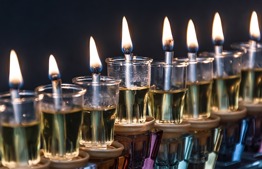
What is Chanukah? The Sages taught: On the twenty-fifth of Kislev, the days of Chanukah are eight. One may not eulogize on them and one may not fast on them. When the Greeks entered the Sanctuary they defiled all the oils that were in the Sanctuary. And when the Hasmonean monarchy overcame and emerged victorious over them, they searched and found only one cruse of oil that was placed with the seal of the High Priest. And there was [sufficient oil] there to light [the menorah for] only one day. A miracle occurred and they lit from it eight days. The next year [the Sages] instituted those days and made them holidays with hallel and thanksgiving.
Here we see a distinct linguistic parallel (easier to see in the Aramaic). With regard to Adam, the Gemara states (Avoda Zara 8a.):
ועשה שמונה ימים טובים ... לשנה האחרת עשאן לאלו ולאלו ימים טובים, הוא קבעם לשם שמים
He went and observed a festival for eight days … The next year, he made both these and these days of festivities. He [Adam] instituted [these festivals] for the sake of Heaven.
In the context of Chanukah, similar terminology is used (Shabbat 21b):
והדליקו ממנו שמונה ימים. לשנה אחרת קבעום ועשאום ימים טובים בהלל והודאה.
… they lit from it eight days. The next year, the Sages instituted those days and made them days of festivities with hallel and thanksgiving.
The Gemara connects these two incidents when defining Chanukah, showing that it is a natural festival with roots in an ancient holiday from the beginning of time. Afterwards, Judaism poured in the content of inauguration and dedication—in Moshe's time with the Mishkan, during Chaggai's time, and finally in the time of the Greeks and Hasmoneans. However, it's source is with Adam!
Christianity, whose holidays were borrowed from pagan festivals and influenced by Chanukah as well, observe their holiday on the 25 of the month (albeit, of the solar rather than lunar month).
The Beit Hamikdash, built as a sanctuary for G-d, was defiled by pagans, only to be purified once again by the Hasmoneans. So, too, the ancient Chanukah was originally a festival instituted for G-d's sake, defiled (turned Saturnalia), and then purified and rededicated to G-d by the Hasmoneans.
The essence of Chanukah
Chanukah is meant to redeem the concept of light and fire! Chanukah symbolizes the power of human action, which G-d wants us to engage in. Even when the world is dark and cold, we humans are charged with warming and lighting it up. And even when we encounter injustice and immorality, we need to remember that "a bit of light dispels much darkness." The actions of one person can make a difference and illuminate the world. Even a small cruse of oil—even one candle—can change the whole world.
Happy Chanukah!