Pesach: Instructions for Baking Hand Matzah
This article covers the entire matzah baking process, from baking preparations, through dough preparation and docking, baking, challah separation and cleaning.
For the original article in Hebrew, see here.
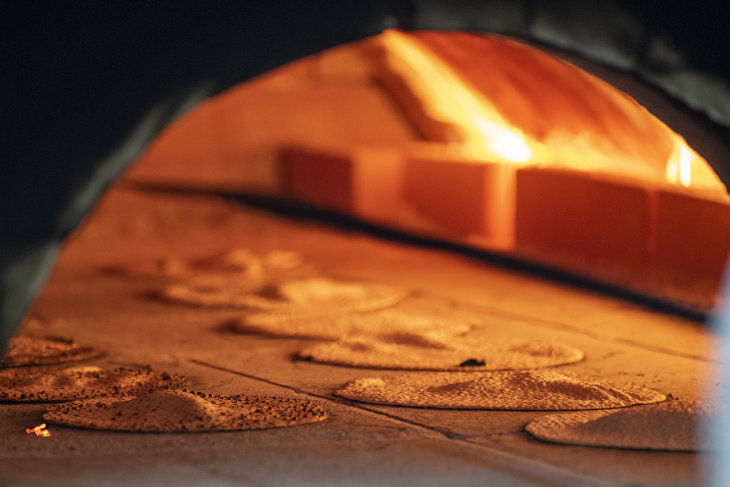
Photos: Aish HaTorah
A. Preparations for Baking
1. Flour
a. For baking matzah, it is preferable to use wheat flour,[1] but if necessary, rye, spelt, or oat flour may also be used. Regular flour sold commercially is moistened before milling, so for matzah baking one must use special flour whose grains have not been moistened at all.[2]
b. When baking matzah for the Seder night, one should ideally use flour preserved from the time of harvest,[3] and some are stringent to do so for all matzot eaten during Passover.[4] (Some have the custom to use hand-milled flour rather than machine-milled.)
c. Flour that comes into contact with moisture sours. Therefore, store flour in a dry place and avoid placing it on a damp floor or in a generally humid location. It is recommended to wrap the flour in two tightly sealed packages so that even if one develops a small hole, the flour will not become wet.
d. Take care that the flour is not warm at the time of baking, as heat accelerates souring. It is therefore advised not to use flour on the same day it is milled, since the milling process generates heat,[5] though in urgent cases it may be used after one night has passed.[6] Store flour in a cool, shaded place, transport it under similar conditions,[7] avoid touching it unnecessarily,[8] do not stack flour bags,[9] and do not sit on them.[10]
e. Matzah flour is coarser than regular flour and cannot be sifted through a normal sieve. This can be resolved by using a sieve with wider holes (ideally replaced yearly), or by purchasing flour milled that same day (before any insects can appear) and storing it refrigerated or frozen, eliminating the need for sifting.[11]
2. Water
a. Tap water may be used for baking matzah,[12] though those who are stringent often use water from springs or streams. It should be filtered through a clean, dense cloth to ensure no worms, debris, or impurities remain.[13]
b. Storing the water is part of the matzah baking process, so ideally it should be designated for "matzot mitzvah".[14]
c. To prevent the dough from souring, the water should be cool. The Sages established several rules for this:
- Fill the receptacle with water at nightfall, when it is coldest, and let it cool further overnight.[15][16] If water was drawn earlier in the day, or at night before midnight, it may be used the next day after 12 hours have passed since drawing.[17] If insufficient water was drawn for the matzah, additional regular water may be added, provided it does not exceed the amount of water drawn earlier.[18]
- Do not use previously warmed water (e.g., from a kettle or solar heater), even if cooled.[19]
d. Store water in a cool, shaded place,[20] and if transporting during the day, use a sealed container (if the container is see-through, cover it from all sides).[21] Do not store water in containers that previously held juices or fruit liquids unless hagalah was performed before use.[22]
3. Utensils and Baking Area
a. To bake quickly, use efficient utensils that dough does not adhere to. Stainless steel with minimal grooves is preferred since it is easy to clean;[23] avoid wooden tools since crumbs and dough and be trapped in the cracks.[24] Some wrap work surfaces in disposable plastic or paper for easier cleanup, to obviate the need for cleaning the surface.
b. Hands and clothing must be thoroughly clean of dirt or chametz, sleeves rolled up, watches removed, and nails trimmed, to avoid residual yeast and chametz.
c. Designate utensils specifically for matzah baking; do not use utensils or baking tools used year-round for dough preparation unless properly kashered through hagalah. Prior to baking, check for any leftover dough crumbs from matzah baking in previous years.
d. Heat accelerates souring, so avoid sunlit windows even if sunlight is not currently entering,[25] and keep the dough preparation area away from the oven where residual heat may be felt.[26]
B. Baking Time
a. Some posekim recommend baking matzah after midday on erev Pesach, at least for the matzot used for the Seder.[27] Others avoid this, as chametz prohibition has already begun, and crumbs could sour or be mixed with dough, or the flour may contain chametz.[28]
b. Those baking after midday should declare before starting: "כל פירורים שיפלו בשעת לישה ועריכה וכן בצק הנדבק בכלים, אנחנו מבטלים אותם"", “Any crumbs that fall while kneading or stick to utensils, we hereby nullify,” preventing inadvertent violation of the chametz prohibition.[29] Also, ensure readiness to quickly destroy any leftover crumbs by fire or a neutralizing solution.[30] Due to these concerns, most communities refrain from baking matzah during the festival.[31]
C. Baking the Matzah
1. Intent (“Leshem Matzot Mitzvah”)
a. When baking matzot for the Seder, intention is required, and the custom is to verbalize: "leshem matzot mitzvah" “for the mitzvah of matzah.”[32] [33]. Some customarily sing or say this phrase throughout the preparation and baking process. Children under bar/bat mitzvah age or non-Jews should not participate, as they are not obligated in the mitzvah and their intent does not count;[34] some allow for underage children to make holes in the matzot.[35]
b. When matzot are baked after chatzot, some reciting Hallel, commemorating the Pesach sacrifice when Hallel was recited.[36]
2. Mixing Flour and Water
a. To ensure that the dough does not become sticky, do not use excessive water. On the other hand, to make sure the flour is easy to work with and all of the flour is moistened, do not use less than the required amount. Water ratios depend on desired matzah texture: for hard matzah, ~½ unit water per 1 unit flour; for soft, ~⅔ unit water per 1 unit flour. Ratios vary by flour type; test beforehand.
b. The Sages note that batches larger than the amount requiring the separation of challah (some opinions state 1.2 kg, while others 1.6 kg) are hard to knead properly.[37] Therefore, some avoid preparing batches larges than this amount; many are lenient in this regard, however, since today the kneading utensils are more professional and higher quality than they were in the past.[38]
c. Once water is mixed, dough may sour if left idle; before mixing, check that the utensils, oven, and those participating in matzah preparation are ready to begin the baking process.
d. Do not add flour to the dough afterward, as it may not integrate and cause souring during Pesach. If dough is too thin, prepare separate thick dough and combine afterward.[39] It is important to distance the kneading area from the flour bag, so particles of flour do not fly into the dough. For this reason, whoever brings the flour should check that particles of flour did not adhere to it that could integrate into dough.
e. Pour water gently to avoid scattering flour into the water container.
f. For mitzvah matzah (for eating at motzi matzah and afikoman), only flour and water may be used. For other Passover matzah, no spices are added. [40] Most communities customarily avoid adding salt [41]. In any event, it is forbidden to use liquids for the dough other than water. [42]
3. Dough Preparation
a. In professional bakeries, rods are used to forcefully knead the dough and make it suitable for shaping. Since it is very difficult to clean the joint where the rod connects to the work surface, it is advisable to cover it in disposable plastic and replace the plastic each time the area is cleaned. Afterward, the dough is divided for shaping with a rolling pin.
b. Dough cannot sour for 18 minutes without kneading, but ideally should not sit idle.[43] Large batches require someone to remain kneading until all dough is prepared.
4. Docking (Piercing) the Dough
a. The prevalent custom is to pierce holes in the dough to prevent puffing while baking (but it is not mandatory).[44] One who does not have a professional tool for this (radler, or matzah docker; a roller with multiple spikes or pins), can perforate the dough manually with fork or knife, but not if too much time goes by because of this.
b. Dough left idle after rolling may sour quickly.[45] Ensure enough workers are ready for docking to avoid delay and the matzah; the ones rolling the matzah should not pass on dough to those docking it unless they are available.
5. Baking
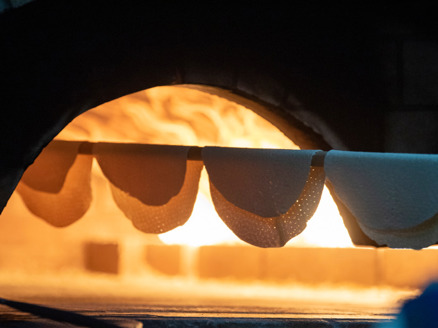
a. Even minimal heat may cause souring;[46] however, once the matzah is inserted into the oven, it is baked and no longer sours even if it is there for a long time. For this reason, it is important to preheat oven before inserting matzah.[47] Do not put matzot in the oven placed on cold trays or baking paper ,[48] since it will take time until they warm up and thus prolong the time until the matzot are baked.
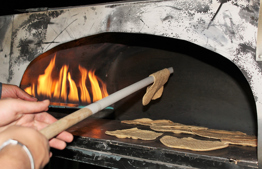
b. As stated above, it is forbidden for matzot to come into contact with heat before insertion into the oven. Therefore, when using utensils or rods to insert the matzot into the oven, either change the heated utensils or wait until they cool completely before they come into contact with the matzot[49] (ensure you have sufficient utensils for this purpose). Similarly, make sure that no dough crumbs remain on the utensils that may integrate into the next matzah batch [50] (when using wooden rods, some customarily clean them between each matzah with sandpaper; others are stringent and wrap the rods with paper and switch the paper between matzot.
c. Do not place the matzah at the oven entrance before baking.[51] Therefore, the person in charge of inserting the matzot needs to decide ahead of time where to place the matzot before putting them in the oven to avoid a situation in which he will deliberate where to put them while they are near the oven.
d. Matzot that folded over were not baked thoroughly. The same is true for matzot that touched another matzah during the baking process.[52] For this reason, take care to lay them flat in the oven and space them sufficiently from one another.
e. Matzah is considered baked only after the upper surface changes color ("sheyakrimu paneha").[53]; do not remove the matzot from the oven before this occurs[54] (if one removed it and put it back immediately, bediavad, it is not disqualified).[55]
f. After the matzot are baked, inspect the matzot for folded sections or matzot that touched each other. Remove the doubled section plus 2 cm (this is the same for two matzot that touched each other).[56]
g. If matzot puffed excessively, more than the thickness of a thumb, consult a competent halachic authority.[57]
h. Keep baked matzah away from flour to prevent flour from sticking to the matzot.
D. Separating Challah
a. Those who prepare large batches that are obligated in challah separation should separate challah after kneading. Those stringent to prepare small batches below the challah obligation threshold should place the baked matzot into a receptacle or bag together or place a covering over all of them[58] and then separate challah from one of the matzot.
E. Cleaning
a. It is technically permissible to bake without stopping in the middle since as long as the dough is handled it does not sour. However, many are concerned that crumbs will stick to tools that were not in use, and these will later mix in to the dough. For this reason, each 18 minutes, there is a stringency to stop and clean all tools before starting new dough.[43] (The beginning of the 18 minute period is measured from the time the flour is mixed with water.) After 18 minutes, do not start another batch; but for matzot that are in already in various stages of preparation, it is permissible to complete the process and bake it.
b. Clean all of the tools and utensils thoroughly, especially the docking tools (radlers), using steel brushes. For metal tools, it is possible to torch them, but they need to cool completely before they can be used again. It is also possible to use disposable docking tools and dispose the used batch, replacing them for the new batch. Wash hands between shifts.
c. Some wrap surfaces in plastic or paper and replace during the cleaning period; workers may wear gloves.
Footnotes:
[1] Shulchan Aruch (SA), OC 453:1; Remah ad loc.
[2] SA, ibid., §5.
[3] SA, ibid., §4.
[4] Sha’arei Teshuvah on SA, ibid., §5.
[5] SA, ibid., §9.
[6] Mishnah Berurah (MB) on SA, ibid., §42.
[7] Remah, OC 459:1.
[8] MB, §456:4.
[9] Rema, OC 453:7.
[10] MB, 453:36.
[11] Some are stringent to avoid freezing flour out of concern that moisture may mix into it. Based on testing I conducted, if the flour is sealed in an airtight bag, there is no concern.
[12] Some are stringent not to use tap water because it contains disinfectants, and there is concern that these may accelerate the leavening process (see Sha’arim HaMetzuyanim BaHalacha 109:3). In practice, however, most machine-matzah bakeries use tap water. This is also the ruling in Halichot Shlomo (Auerbach), ch. 7:3, this is the ruling of my Rabbi and teacher, Rabbi Elyakim Levanon.
[13] MB, §455:12.
[14] MB, ibid., §23.
[15] SA, ibid., §1.
[16] When intending to bake on Sunday, ideally the water should be drawn on Thursday. If not, it may be drawn on Friday before candle lighting, or on Saturday night (in which case one must wait 12 hours before using it).
[17] MB, ibid., §4.
[18] SA, ibid., §4; MB §38. It appears that after adding, one may add again, and all the water is considered “mayim shelanu,” based on the principle of “each increment is nullified,” as discussed (in reverse case) in Pri Megadim, OC, Eshel Avraham 160:7.
[19] MB, ibid., §29; see there for leniency in pressing circumstances.
[20] SA, ibid., §1.
[21] MB, ibid., §13.
[22] MB, ibid., §25.
[23] One may also use long stainless-steel rods as rolling pins.
[24] Rema, OC 459:4.
[25] SA, OC 459:1; Rema ad loc.
[26] SA, ibid.
[27] SA, OC 458:1.
[28] See MB, ibid., §3.
[29] SA, OC 460:3.
[30] MB, ibid., §9.
[31] MB, 458:4.
[32] SA, OC 460:1.
[33] See Bi'ur Halacha, ibid., s.v. ein lashin.
[34] SA, ibid.
[35] MB, ibid., §1.
[36] The Siddur of the Arizal; also cited in the name of the Chida.
[37] SA, OC 456:1.
[38] MB, ibid., §7.
[39] SA, OC 459:6.
[40] SA, OC 455:6.
[41] SA, ibid., §5.
[42] SA, OC 462:2.
[43] SA, OC 459:2.
[44] SA, OC 460:4.
[45] SA, OC 459:2; Bi'ur Halacha, ibid., s.v. ve’achar she’nitasku.
[46] SA, ibid., §1.
[47] SA, OC 461:2.
[48] MB, ibid., §11.
[49] MB, §459:10.
[50] MB, ibid., §32.
[51] MB, ibid., §10.
[52] Remah, OC 461:5.
[53] SA, OC 461:3; MB, ibid., §15.
[54] Remah, ibid.
[55] MB, ibid., §16.
[56] Remah, ibid., §5; MB, §32.
[57] Remah, ibid.; MB, §34.
[58] SA, OC 457:1; MB, §7.