Khat – Plants in the Garden of Mitzvot
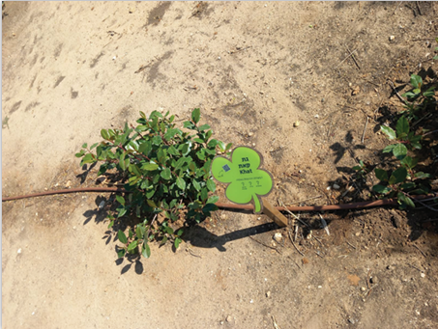
Khat is an evergreen perennial woody shrub. Its leaves are traditionally chewed as a stimulant. Since khat is halachically considered a tree, are the leaves considered "fruit"? Are they subject to the orlah prohibition?
The khat plant (Catha edulis) grows in our Garden of Mitzvot, in the plot of bushes and trees. It is indigenous to Ethiopia, Yemen, and Oman, where it is cultivated as an agricultural crop. In Israel, the plant is known as gat, while in Yemen it is called qat. Khat is an evergreen shrub that can reach up to three meters in height. Its young leaves contain active substances, cathine and cathinone, which are considered mild-to-moderate psychoactive compounds. Chewing the leaves for several hours can produce euphoria, heightened alertness, and a sense of satisfaction. Occasional use is not generally considered addictive, and its effects are relatively mild.
In addition to these psychoactive substances, khat leaves are rich in nutrients, including iron, vitamin C, calcium, and beta-carotene—often exceeding the content found in most leafy greens. In Hebrew, the plant is called khat ne’echelet, or “edible khat,” though in practice the leaves are not swallowed; they are chewed and eventually discarded.
Because of the presence of cathinone, khat is prohibited in the United States, Great Britain, and other countries. In Israel, however, its use is permitted in natural form, but not in processed forms such as pills or with additives. Today, about 100 hectares of khat are grown commercially in Israel and sold to green groceries and stores.
Now for the halachic question: Since the plant is a woody perennial, whose leaves are chewed and benefit is derived from its taste, is it subject to orlah laws?
The orlah prohibition is derived from the verse (Vayikra 19:23): "When you enter the land and plant any tree for food, you shall regard its fruit as forbidden. Three years it shall be forbidden for you, not to be eaten." The Yerushalmi (Orlah 1:1) explains that orlah applies only to trees whose fruit is eaten. The question then becomes: does chewing leaves and swallowing its juice considered "eating"?
The Radbaz (§563) writes that the orlah obligation does not apply to sugarcane, since only the sap extracted from the canes are used while the canes themselves are inedible; the Torah only obligated fruit, as it explicitly states "its fruit as forbidden," and sap is not considered fruit. In this vein, the Chazon Ish writes (Dinei Orlah §39) that plants serving as an herb, whose leaves are used for flavor and not actually eaten, are exempt from orlah.
Furthermore, the Radbaz (§499) notes that a tree planted for medicinal purposes is not considered a fruit tree.[1] Based on the above, the khat plant is exempt from orlah, since its leaves are chewed as a stimulant and mood-enhancing effects, not for food. Indeed, Rabbi Yosef Kapach attested that the Yemenite Jewish community did not observe the orlah prohibition for khat.
For more information on khat, see our plant database here.
[1] See the article by Rabbi Yehuda Amichay, HaTorah Veha'aretz V, pp. 129–130.