
Sugarcane - Plants in the Garden of Mitzvot
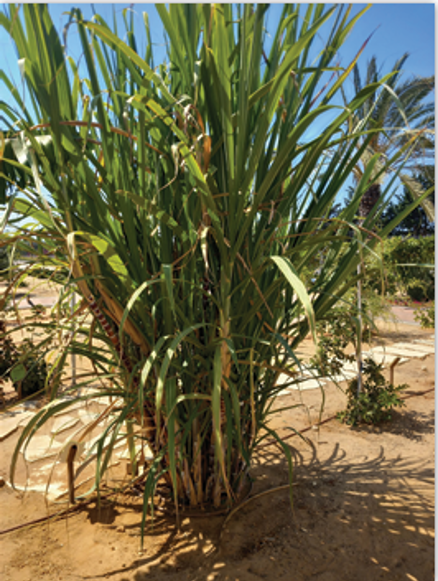
Sugarcane plays a key role in the global food and sweetener industries and in the production of paper, cosmetics, and renewable “green” energy (biodiesel) for vehicles. A woody perennial, it can reach 7 m and last for several years. Is it obligated in orlah? What about terumot and ma'aserot?
The plant from which most of the world’s sugar is produced today is the sugarcane (Saccharum). This plant grows with remarkable vigor in the botanical Garden of Mitzvot at Torah VeHa'aretz Center in Nitzan. Within about a year and a half, it reached a height of approximately three meters, and it continues to grow — ultimately reaching up to seven meters when fully mature.
Sugarcane belongs to the grass family. It is a perennial plant that grows from an underground rhizome. Its stems — which are actually solid canes rather than hollow like most grasses — persist for several years. New shoots emerge from the rhizome and, within a few months, develop into tall, sturdy stalks.
The main use of sugarcane is the production of sugar — the world’s most common (albeit, not necessarily healthiest) sweetener. In fact, nearly every part of the plant is used industrially. During the refining process that produces white sugar, a sugar syrup is also forms, which serves as an important ingredient in cooking and baking. Sugarcane is also used to produce alcoholic beverages such as cachaça and rum. After the sugar is extracted, the remaining fibrous material is used as animal feed, and today it is also processed into biofuel — ethanol — through microbial fermentation. This ethanol has about 80% of the energy value of gasoline, yet it burns cleanly and does not pollute. The plant is also used to produce paper and a wax used in the cosmetics industry.
In short — an impressively versatile and efficient plant.
The leading sugarcane-producing countries today are India and Brazil. In the past, sugarcane was grown in Israel with yields far exceeding those of most commercial producers. However, commercial cultivation here ceased due to economic considerations.
Some have identified sugarcane with the “good cane” mentioned in Jeremiah (6:20) and Isaiah (43:24), and with the sikurah mentioned in the Jerusalem Talmud (Shabbat 7:2; Beitzah 4:5).
Halachic Status
The halachic classification of sugarcane is complex — which is precisely why it was planted in the Garden of Mitzvot. It is a perennial plant whose stalks remain viable for many years. In the Garden of Mitzvot at Kfar Darom, we marked the stalks and observed that they indeed survived for several years.
Because its stems are woody, most posekim consider sugarcane a halachic tree (HaTorah Veha'aretz VIII pp. 102–110). However, the prohibition of orlah does not apply, since the plant is not eaten for its fruit but for the juice extracted from its stalks (Responsa Radbaz I §563, III §531). For the same reason, most posekim exempt sugarcane from terumot and ma'aserot.
As for the proper blessing, opinions vary: some say ha’etz, others ha’adamah, and still others shehakol (see Radbaz, ibid., and Kaftor Vaferach ch. 56).
Summary
Sugarcane plays a key role not only in the global food and sweetener industries, but also in the production of paper, cosmetics, and renewable “green” energy (biodiesel) for vehicles. Truly impressive — a living example of the verse: “How great are Your works, O Lord; You have made them all with wisdom; the earth is filled with Your creations” (Psalms 104:24).
For the original article in Hebrew, see here.
For more on sugarcane, see here.