The Five Grains – Plants in the Garden of Mitzvot
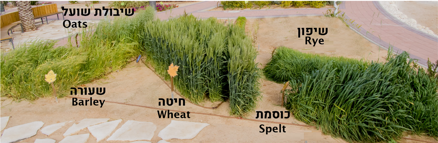
One of the unique plots in the Garden of Mitzvot is dedicated to the Five Grains. It is rare to find all of the five grains growing side by side as they are in the garden now. Which verse in Shemot is easier to understand when you see this plot?
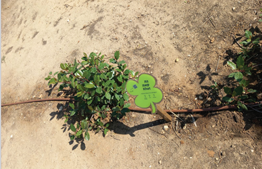
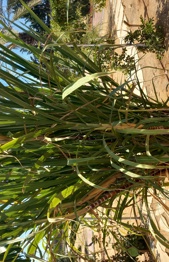
One of the unique plots in the Garden of Mitzvot is dedicated to the Five Grains. It is rare to find all of the five grains growing side by side as they are in the garden now. Chazal defined the five grains as chitah, se'orah, shibolet shu'al, kusmin, and shiffon, commonly rendered as wheat, barley, oats, spelt, and rye. Since scholars differ regarding the precise identification of some of these species, we planted several wheat varieties in the garden. Kusemin, spelt, closely resembles wheat; but it should not be confused with kusemet, buckwheat. The latter is a legume and is unrelated either to wheat or to spelt. These five species have different growth and ripening rates, which can clearly be observed in the plot.
Seeing these grains together illuminates the Torah's description of the plague of hail: "And the flax and barley were stricken since the barley was in the ear (ripening early) and flax was in the bud, but the wheat and spelt were not destroyed for they ripen late" (Shemot 9:31–32). Barley indeed ripens earlier than wheat. For this reason, the omer offering brought on Pesach was composed of barley, while the shetei halechem offering brought on Shavuot was composed of wheat.
Today, the Five Grains remain staples throughout the world, along with rice. While rice is not considered one of the Five Grains, Chazal granted it a special status, requiring the blessing of mezonot, similar to foods made of the Five Grains.
The Torah assigns special significance to the Five Grains in many mitzvot: they are biblically obligated in the separation of terumot and ma'aserot; challah must be separated from their dough; they have distinct distancing requirements regarding kilei zera'im and kilei hakerem; they may be used for the mitzvah of eating matzah on Pesach and their leavened products are considered chametz throughout the holiday; they are used for the omer offering on Pesach and the shetei halechem offering on Shavuot; and a special blessing is recited before and after eating them.
Chazal also derived various halachic measurements from grains of wheat and barley, including for the laws of purity, impurity (tumah vetaharah) and Shabbat, among others.
Chazal praised wheat in particular, stating (Ketubot 111b): "In the future, wheat will rise up, and grow tall like a palm tree, and ascend to the top of the mountains … from which he will [provide] his livelihood and the livelihood of the members of his household."
Indeed, wheat remains the most basic staple in Israel today. Historically and in modern times, wheat cultivation in the Land of Israel has been grown through dry-land farming, without irrigation, relying solely on the rain that G-d provides us with from above. King David alludes to this dependence on rain in Tehillim, psalm 126, which we also recite before birkat hamazon, "Though he goes along weeping, carrying the seed bag, he shall come back with songs of joy, carrying his sheaves."
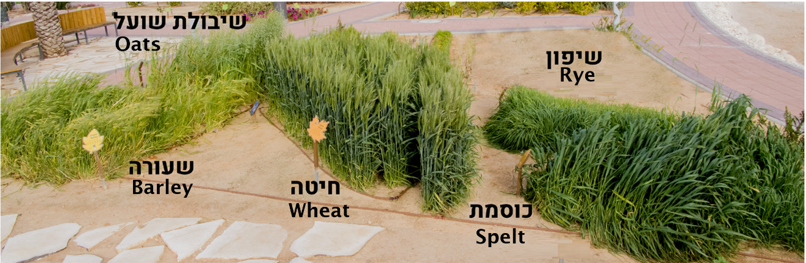
The Five Grains in the Garden of Mitzvot
Addition by Rabbi Bloom: Note that normally, a distance of 2 amot (96 cm) should be maintained between different types of grains to avoid transgressing the laws of kilei zera'im. However, since we grow them in distinct shapes (rosh tor) in the Garden of Mitzvot, it is permissible to grow them near one another.