Is monk fruit considered orlah?
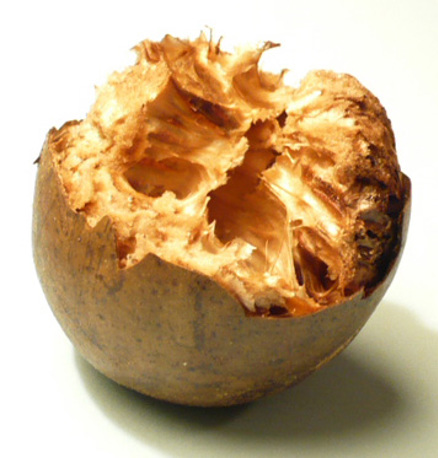
A mashgiach of a large kashrut organization, who works in China, checked a company growing monk fruit in a greenhouse onsite. He found out that since monk plants produce the most fruit the first years, the company harvests the fruit only from monk plants during their first three years. In light of this, is monk fruit considered orlah?
Answer :
The mashgiach from the OU (the OU provides the hechsher for the product) told me that at least two factories receive new monk plants each year. It seems that this would pose a problem of orlah, since the fruits are harvested within the plants' first three years. There are only a few other factories that produce monk fruit in that area in China. There are no other factories like it in the world.
A. What is monk fruit?
Monk fruit (Siraitia grosvenorii) is a perennial, used as a natural sweetener, without sugar, calories, or aftertaste, originating in China. It is FDA approved from 2010 as a sweetener, 100 times sweeter than white sugar. It can be ordered in Israel through IHERB, certified by the OU. The sweetening agent is produced after seeding the fruit. The fruit is ground and the liquid extract is gathered.
B. Monk fruit: a tree or vegetable?
The work practices of farmers or corporations do not have any bearing on the definition of the species. That is—if a species is halachically classified as a tree, even if growers decide to cultivate it in a different way for convenience' sake (such as growing it for two years and uprooting it), this does not necessarily change its halachic definition to be a vegetable.
The monk plant tree definitely produces fruit within the first year, so according to the Radbaz and others (mostly Sephardi posekim), it not considered a tree at all—so there would be no issue of orlah.
Even if we are concerned that it is a tree, as long as we are not 100% certain that what we are buying is from a tree in its orlah years, it is considered safek orlah—since we haven't checked all of the factories producing monk fruit. Outside the Land of Israel, safek orlah is permitted.
Since there is a doubt whether the fruit is orlah and there is a dispute as to whether the plant is indeed a tree, we can be lenient.
In practice: at this point, there is no issue of orlah for this product.
(From my conversation with the mashgiach, it seems that the OU provides certification for the monk fruit by mainly relying on the opinion of the Radbaz—but I haven't seen an official written statement from the OU on this matter).
If in the future it turns out that all of the monk plant factories follow the same practice, or that the products certified by the OU all come from factories that work this way, then no longer will there be a doubt about orlah. We would then have to reexamine the matter.
C. Lessons from Hawaiian pineapples
However, even in this case, it seems that we can be lenient based on a comment at the end of a responsum by Rabbi Yosef Efrati (Halichot Sadeh 201, Nissan 5778) on pineapples. Some claim that pineapple plants should be considered trees, since in Hawaii they were grown in the past for more than three years. Today, however, their standard method has changed and pineapples are harvested within the first three years. Does this mean that all the pineapples from Hawaii are prohibited for consumption, since they are certainly orlah (orlah vaday)?
Rabbi Efrati asserts that outside the Land of Israel, as long as the end-consumer does not actually see the fruit being harvested from an orlah tree, it is permitted to eat—even if it is certainly orlah (according to some of the Rishonim). It follows that this would certainly be permitted if there it is safek orlah – since pineapples are not considered a tree according to most posekim. This is one of the reasons to permit pineapples. (See also Halichot Sadeh 204, p. 49, on pineapple cultivation in Hawaii).
It seems that we can employ the same line of reasoning to monk fruit. The plant does not grow in Israel and some hold that it is a vegetable. There might also be other characteristics that can classify it as a vegetable, such as a hollow trunk and a lower quality and quantity of fruit from year to year. So, even if we know with certainty that all of the monk fruit is harvested in the plant's first three years, it would still be kosher.
If local farmers should decide to cultivate monk fruit in Israel, a comprehensive study is called for to examine the plant's characteristics. Orlah in the Land of Israel is a biblical prohibition, and even safek orlah is prohibited.