Rooted or not? Halachic correspondence with contemporary posekim on planting trees after 15 Av
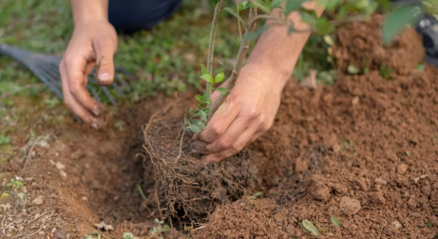
Many plantings take place during the end of summer, especially citrus trees. These plantings are always done with an intact clod of soil. Since it is sometimes difficult to complete all plantings by the 15th of Av (Tu B’Av), the question arises: Can the planting deadline be postponed by another two weeks, on the assumption that a tree planted with a clod of soil does not require time to take root?
Many plantings take place during the end of summer, especially citrus trees. These plantings are always done with an intact clod of soil. Since it is sometimes difficult to complete all plantings by the 15th of Av (Tu B’Av), the question arises: Can the planting deadline be postponed by another two weeks, on the assumption that a tree planted with a clod of soil does not require time to take root?
We presented this question to several of the halachic authorities of our generation, and below is the correspondence.
Dear Rabbi Dov Lior, Shlit”a
Greetings and blessings!
I was uncertain regarding transferring a tree grown in a clod of soil in a non-perforated pot. Must one plant such a tree specifically by Tu B’Av in order to count that year for orlah, or may one delay until the 29th of Av?
The doubt arises based on the Rambam (Maaser Sheni 9:12), who rules that 44 days are required: 30 days to count as a year, and 14 days for the tree to root. On the one hand, one could argue that a tree in a clod of soil is already considered “rooted,” so planting it 30 days before Rosh Hashanah is sufficient. On the other hand, perhaps rooting in a non-perforated pot — which is not considered a location obligated in orlah — is not valid. The reasoning is that some say the act of planting is what obligates orlah, as it says, “When you plant” (see Har Tzvi, Zeraim II §14). According to this view, rooting is merely the completion of the planting, similar to what we find in the laws of Shabbat (see Eglei Tal, Zore’a §8). Therefore, if a plant grows in a non-perforated pot and is then transferred to the ground, a new rooting process in the obligated location is required, and the count begins from the time the tree takes root (see Kesef Mishneh on Rambam ibid, Chazon Ish, Orlah §12 s.k. 5). Hence, in our case, one should be careful to plant by Tu B’Av.
With blessings for Torah and the Land,
Yoel Friedemann
Torah VeHa'aretz Institute
Response of Rabbi Dov Lior, Shlit”a
Dear Rabbi Yoel Friedemann
I received your question, and due to its urgency, I hasten to respond with what seems correct in my humble opinion.
You asked whether one who plants in a non-perforated pot and wishes to transfer it to the ground must do so before Tu B’Av for it to count as one orlah year. It appears your question focuses only on pots made of materials such as metal or glass, where we do not say that the roots penetrate. For pots made of earthenware or wood, "it is like the ground for trees" because roots can penetrate (as Acharonim understood Rambam — Maaser Sheni 10:8 — see Radbaz, Vilna Gaon on YD §297:4, Aruch HaShulchan YD §294:4). Therefore, plastic bags in our day are considered perforated pots, even though they have very small holes, since roots can penetrate through them to the ground. Thus, your question is not so common, as planting is not generally done in metal or glass pots.
Seemingly, this doubt could be clarified from a similar halachah. The Rambam writes (Ma'aser Sheni 10:2): "If he planted it to serve as a hedge and then changed his mind and thought to eat its fruit… it is obligated," and the Shulchan Aruch (YD 294:23) rules that the orlah count begins from the time of planting, not from the change in intention. Although at first the tree was exempt, it is still counted from when it was physically planted. This seems to show that the act of planting is not what obligates orlah. However, after some consideration, this case is not comparable. There, one could change his mind immediately and designate it for food use, whereas in our case — where the plant was in a non-perforated metal pot — mere intent does not suffice.
Yet, the Rambam brings another halachah (ibid. 10:10): If a gentile grafted a fruit tree onto a non-fruit tree (ilan seraq)— it is subject to orlah. From the plain reading of Rambam's ruling, we learn that even if there were no fruits on the non-fruit tree, we would still begin the orlah count from the time the non-fruit tree was originally planted. This differs from the approach of Ramban and Ritva (Rosh Hashanah 10a), who say this only applies if the non-fruit tree bore poor fruit. But for a genuine non-fruit tree with no fruit at all, the count starts from grafting. Thus, our case seems to be a disput between Rambam and Ramban: While Rambam maintains that even if there was no orlah obligation at the beginning (since there were no fruit at all), we consider the fact that the tree was physically planted, so we count based on the time it was planted originally. Ramban maintains, in contrast, that the time of obligation begins only from the time there is a requirement. Based on this, a tree would need to take root after being planted in the ground.
See also Chazon Ish (Dinei Orlah §32), who notes this doubt regarding a tree grown in a metal pot and later planted it in the ground together with its clod of soil that can sustain it — whether the count starts from the original time it was planted in the pot, or from the time it was planted in the ground. [1]
Upon further reflection, our case is different. The issue here relates only to the calculation of rooting time, not the orlah year count for a tree in a metal pot. The halachah requires two weeks for a tree to take root (Rambam, Ma'aser Sheni 9:8, based on Yerushalmi Shevi’it 2:4). Rambam (ibid.) writes: "How much is the typical rooting time for all trees? Two weeks." We can imply from Rambam's phrase “typical rooting time,” that if it’s known for certain that rooting occurred in less than two weeks (e.g., ten days), that suffices; according to this understanding, the two-week typical rooting time rule serves to cover all trees. I have also seen this opinion by one of the great Acharonim, that if it is clear that the tree took root in ten days, this is sufficient. [2]
Returning to our case, since the plant is transferred with its soil ball and can live in it, even one day before the 30 days (required to count as a year) is sufficient — because the when the soil ball merges with the ground, it becomes nullified to it and no new rooting occurs. Therefore, since this is only a question of rooting time, there is no need for two weeks. Still, one must plant at least 30 days before Rosh Hashanah.
In conclusion: There is no need to wait two weeks. One day is sufficient.
— Rabbi Dov Lior
Response of Rabbi Yehoshua Y. Neuwirth, Shlit”a
Dear Rabbi Y. Friedemann, Shlit”a,
Following our conversation, I spoke with Rabbi Yosef Shalom Elyashiv, Shlit”a. His opinion leans toward leniency — since the Chazon Ish [3] leaves the matter unresolved, and the Yerushalmi seems to lean toward leniency as well — therefore in this case, one can be lenient and consider rooting days in a non-perforated pot. After transferring the tree, one must still wait 30 days for it to count as a year. Baruch Hashem, you're thinking was aligned with the opinion of Gedolim.
With blessings of the Torah,
Yehoshua Y. Neuwirth
*Rabbi Yehoshua Neuwirth’s answer was received via fax following a phone conversation.
End Notes
[1] See Chazon Ish §2:13) and Rabbi Kook (Mishpat Kohen §8) wrote that we count from the time a tree is planted in the ground.
[2] Shabbat Ha'aretz 3:11 §1 and n. 5); Chazon Ish (Shevi'it §25:37, Dinei Orlah §6).
[3] Chazon Ish (Orlah §2:13, Dinei Orlah §32)
Editor’s Notes (Rabbi Y. Friedemann) to Rabbi Lior's responsum
1. Modern Nurseries: In light of the situation in nurseries today, in my humble opinion the issue of unperforated pots is quite common. Many nurseries place seedlings on raised concrete platforms. Although there are drainage holes, many plants are placed such that the holes rest on the concrete. In such cases, the pot is considered non-perforated, as the concrete blocks root access to the ground. See Rosh (Gittin 2, §22) that a pot sitting on a higher story of a house is considered unperforated, though he writes in his responsum (Rule 2 §4) that a vineyard planted on a higher story is considered connected to the ground. See also Minchat Shlomo §41:2.
2. Support for Leniency: Rabbi Dov Landau, Shlit”a, referred us to Yeshuot Malko (Kiryat Arba, Kilayim 5:14 §3), who writes that a plant growing in a non-perforated pot is already considered rooted, so sowing and rooting happen simultaneously. See also Minchat Shlomo §§69-70.
3. Plastic Bags: See Torah VeHa'aretz, Vol. I, p. 209, regarding differing halachic opinions about plastic bags and their status as perforated pots.
4. Practical Advice: Although halachically one may plant up until the 29th of Av, it is not recommended — if the soil ball breaks during planting, the planter will lose not only the nursery growth period but also the first year of orlah count.