The basic prohibition of orlah
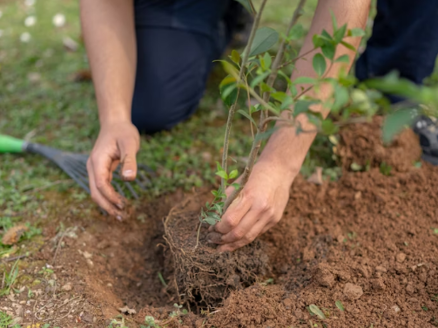
Overview on the prohibition of orlah. From Part II of The Laws of Orlah for the Backyard
"When you enter the land and plant any tree for food, you shall regard its fruit as forbidden. Three years it shall be forbidden for you, not to be eaten" (Vayikra 19:23).
While the Torah clearly prohibits eating fruit of trees in their first three years, Chazal extend this prohibition to benefiting from such fruit.
For this reason, it is forbidden to feed orlah fruit to animals (wild animals included), sell or give it to a non-Jew, or use it for compost. It is also forbidden to smell orlah fruit, light candles from orlah oil, use orlah-produced cosmetics, paint with orlah dyes, or even use orlah fruit as sukkah decorations. However, it is permissible to enjoy looking at orlah fruit not used for decoration (fruit hanging on a tree, for instance).
It is prohibited to benefit from seeds of orlah fruit. If planted, though, it is permissible to benefit from the fruit of the resulting tree (after orlah years are up, of course). Bedi'avad we are lenient, employing the halachic principle of zeh va zeh gorem (both factors contribute); that is, the soil also helps the tree grow.
Some prohibit performing scientific studies on orlah fruit. Others permit this, since direct benefit is not derived from the fruit.
The orlah prohibition relates only to fruit trees, not to trees that do not bear fruit worthy for human consumption. The prohibition relates only to the fruit itself; branches, leaves, and flowers of orlah trees are all permitted.
The botanic definition of "fruit" is the seed responsible for the continued propagation of the species. Halachah, though, defines "fruit" as the part of the plant that is eaten. For this reason, in the case of nopales (the sabra cactus stems), cultivated as edible leaves, the leaves are also considered fruit and are prohibited for consumption. In this case the (sabra) fruit is also edible, so both fruit and leaves are prohibited during the orlah period.
Grape leaves on orlah vines, on the other hand, are permissible for consumption since they are of secondary importance to the grapes, so they are not considered fruit.
Peels and seeds of orlah fruit are also prohibited, so it is forbidden to plant orlah seeds and candied orlah orange peels are off-limits.
Bushes grown for their leaves used as herbs and for tea, where the leaves are thrown away after giving off flavor, are not subject to orlah laws. Examples include: laurel, lemon verbena, and rose petals. This is despite the fact that these plants are considered trees (perennials that renew from the root). Note that Rabbi Mordechai Eliahu is stringent with regard to herbs.
In contrast, plants whose leaves are used as an herb but are eaten (with the dish or salad) are subject to orlah. One such example is the caper bush; here both the unopened buds (capers) and the fruit (caperberries) are subject to orlah (today caperberries are generally pickled). In contrast, their soft shoots are not halachically considered fruit, even though they are also eaten. This is because capers are grown primarily for the fruit. Some are also stringent with regard to the shoots (see Pictures 25 and 26).
Khat (gat in Hebrew) is traditionally chewed as a stimulant (primarily by Jews of Yemenite origin, who can chew it for several hours like gum). Since the leaves are chewed and then discarded, and not actually eaten, orlah does not apply.
Some of the land-dependent mitzvot (such as terumot and ma'aserot) are only effective today as a rabbinic prohibition for various reasons (the second sanctification of the Land of Israel was nullified; a majority of world Jewry does not yet live in Israel, we don't have the Beit HaMikdash or a mizbe'ach, etc.). Orlah, however, is different: it is a Biblical obligation even today.
Orlah is a Biblical prohibition even in the boundaries of olei Mitzrayim. In practice, Israel's Chief Rabbinate rules that orlah applies to the entire State of Israel.
Fruit from a non-Jew's orchard is subject to orlah, in the same way the prohibition applies to Jewishly-owned orchards.