
Banana - Plants in the Garden of Mitzvot
Every child knows that the correct blessing for bananas is borei peri ha'adamah—but have you ever asked yourself why this is so? An overview on the botanic realities behind the banana plant's unique halachic status.
Bananas: Why do we say ha'adamah on them?
Every child knows that the correct blessing for bananas is borei peri ha'adamah—but have you ever asked yourself why this is so? The Garden of Mitzvot features banana plants growing with their fruit clusters. The plants reach roughly two meters in height and resemble a tree for all intents and purposes. Anyone who has ever grown bananas knows that a banana plant can last for a long time: a single plant is planted only once and goes on to produce delicious fruit many years thereafter.
Indeed, some posekim (such as the Rosh) maintain that the banana plant qualifies as a halachic tree. If so, why do we nevertheless treat bananas as vegetables: exempt them from orlah laws and subject them only to the halachot relating to vegetables?
What makes a plant a halachic tree?
The answer lies in a dispute among the Rishonim regarding the intent of the Gemara in Berachot 40a. The Ge'onim, Rashi, Tosafot, and others debate the criteria that define any given plant as a tree or vegetable. Annual plants are clearly vegetables, while olive, pomegranate, and fig plants are definitely trees. The question arises only when a plant shares characteristics of both categories.
The Rishonim proposed several criteria for determining a plant's status as either a tree or vegetable:
The main criterion focuses on the longevity of the above-ground portion of the plant lasts and its capacity for renewal. If the above-soil section of the plant persists for many years, the plant is considered a tree. If it withers annually, it is considered a vegetable. This is Rambam's ruling.
Albeit, the Rosh maintains that a plant that needs to be sown every year to be considered a vegetable, whereas a plant that can persist for many years is classified as a tree—irrespective of how long its trunk persists.
Additional criteria that define a plant as a vegetable appear in the Acharonim, including: a plant that does not live for more than three years (Chazon Ish); a plant whose fruit quality and quantity diminishes from year to year (Maharam Alshich); a plant that goes from seed to fruit in less than one year (Radbaz); and a hollow trunk (Mahari Hagiz).
Botanical properties
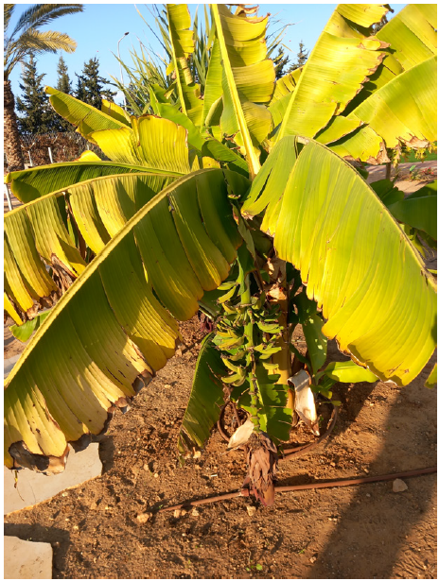
The banana grows from a perennial bulb, from which sprout pseudostems (gizol in Hebrew, a blend of geza, trunk, and givol, stem). The pseudostem is a large herbaceous stem that grows from the bulb; at its top emerge giant leaves that can reach one meter in length. When the pseudostem matures a year after it sprouts, a firm branch grows from it that bears fruit. This stalk emerges from the bulb and ends in a cluster approximately 1 m long, which flowers and subsequently produces fruits (see Picture 1).
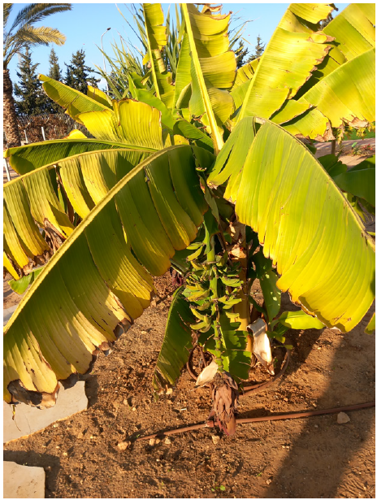
From the bulb, new shoots can emerge for many years. In every such "banana nest," shoots and pseudostems of varying ages are constantly present, forming a big family of sorts (see Picture 2).
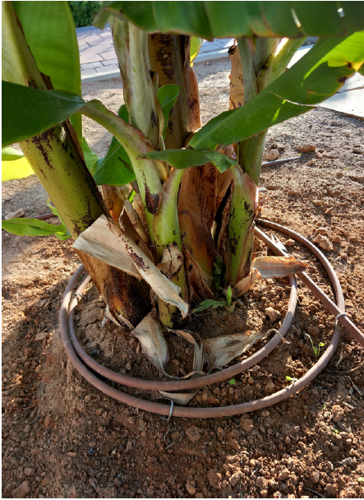
Once the fruit growing on the cluster ripens, the pseudostem that bore it dies. Another pseudostem, which grew alongside it from the same bulb then takes its place and continues the cycle. The Kaftor Veferach points to the banana's pseudostem that emerges from the root and withers after producing fruit as the main criterion defining the banana plant as a vegetable.
Conclusion
According to most posekim, the banana is considered a vegetable and not a tree and is thus exempt from the orlah prohibition. Accordingly, its blessing is bore peri ha'adamah. This ruling is rooted in the short life of each single pseudostem, based on its botanical properties. While the "family" is long lived and produces quality fruit for many years and does not need to be replanted, its halachic status is determined by the short life of each single pseudostem, that dies after fruiting. Visitors at the Garden of Mitzvot can observe firsthand the botanical realities that underlie the plant's halachic status.
For more information on bananas, see our Garden of Mitzvot plant database.