
Separating between plants in flowerpots - what do I have and is the separation sufficient?
Question
Shalom Uvracha!
Attached are two pictures of flowerpots which were planted with spices (a few weeks ago). The flowerpots are mounted on a stone fence. I was told that the spices are at least 15cm apart (does it look it?). I don’t know which spice is which. The gardener gave the following list (although I’m not sure that all of the list is in these 2 specific flowerpots):
לואיזה
מרווה
גרניום לימוני
בזיליקום
אורגנו
טימין
Can you tell from the pictures which is which? And is there a problem of kilayim (or something else)? Kilayim now or kilayim in the future when the leaves grow and overlap? And what I should do to resolve the problem, if any?
Answer
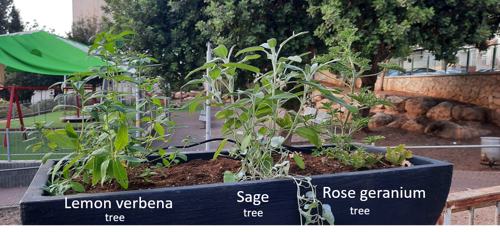
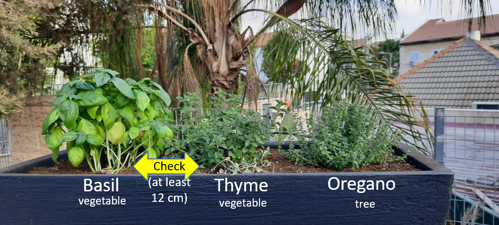
Note that spacing is measured from the point where the stem emerges from the soil, and it’s fine if the leaves overlap later on.
If there isn’t sufficient distance between your basil and thyme, you can either switch the oregano and thyme or move the basil the required amount. (Technically, you could also insert a barrier 80 cm tall, though that solution is less aesthetic.)