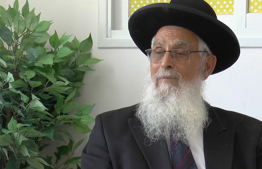
Rabbi Yitzhak Herzog: Rabbinate in Turbulent Times
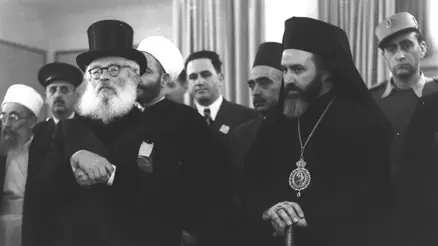
An ambassador of Judaism before presidents and kings, and a visionary legislator of a Jewish state — Rabbi Herzog's legacy spans continents and generations. On the anniversary of his passing, we recall his enduring impact, including his principled stance on women's equality grounded in public acceptance.
This week, on the 19th of Tammuz, we mark the yahrzeit of Rabbi Yitzhak Isaac HaLevi Herzog, who passed away on this date in 1959 (5719).
Born in Poland, Rabbi Herzog moved with his family to England and France, following his father’s rabbinic appointments in various communities. In addition to his profound Torah scholarship, he pursued a broad secular education and earned a doctorate in literature for his research on techelet, the biblical blue dye. Prior to World War II, he served as the Chief Rabbi of Ireland.
With the support of Rabbi Avraham Yitzhak HaKohen Kook, Rabbi Herzog immigrated to the Land of Israel. Following Rav Kook’s passing, Rabbi Herzog was appointed Chief Rabbi in his place. His tenure has been described as a “rabbinate in turbulent times”—a period during which he put his many talents to work on behalf of the Jewish people. He advocated before the British government, traveled to the United States to urge the President to help rescue European Jewry during the Holocaust, and after the war, went to Europe to encourage Holocaust survivors to immigrate to the Land of Israel.
Despite the immense demands of these efforts, Rabbi Herzog also began drafting a constitution for the future State of Israel, even before its establishment. Drawing on his broad Torah knowledge, general education, and intellectual depth, he sought to create a constitutional framework grounded in Jewish law for a sovereign Jewish state.
Rabbi Herzog authored numerous works, including the responsa Heichal Yitzhak. Most of his writings were compiled in the series Ketavim u’Fesakim (“Writings and Rulings”), which addresses a wide range of halachic and societal issues in the context of the modern Jewish state. His political and legal philosophy was presented in a three-volume work titled Techukah le-Yisrael al-pi ha-Torah (“A Constitution for Israel According to the Torah”).
Rabbi Herzog’s political philosophy was rooted in what he called “the sovereignty of Divine law — the Torah from Heaven.” In his view, the State is led by a king, and its supreme legal authority is Torah law. However, the State is permitted to enact supplementary legislation, provided that it does not conflict with halachah. From this perspective, Rabbi Herzog believed that the State of Israel possesses the authority of a Jewish monarchy and that certain laws enacted by the Knesset could carry halachic validity — functioning as rabbinic enactments, so long as they do not contradict the Torah. This approach, which he termed the "model of supplementation," sees Torah law as adaptable to changing realities, and led him to formulate many halachic regulations in a wide range of areas.
To illustrate Rabbi Herzog’s political thought, I have chosen to focus on the issue of granting women equal political rights. According to Rambam (Mishneh Torah, Laws of Kings 1:5), a woman may not serve in positions of public authority: “All appointments in Israel are to be made only from among men.”
Later halachic authorities grappled with Rambam' statement — especially in light of the absence of a direct source in the Talmud — and various interpretations were offered to permit women to hold public office, under certain conditions. One of the more fundamental arguments for allowing women to serve in public positions is based on public acceptance.
Devorah the Prophetess judged and led Israel, and early commentators asked: how could a woman serve as a judge? Their answer was that the people of Israel accepted her authority — and such public acceptance is halachically effective, just as an individual may appoint a relative to judge him.
Further support comes from a Midrash (Kohelet Rabbah 2), which says that King Solomon had "shiddah and shiddot" — interpreted as male and female judges. From this, Rabbi Chaim David HaLevi (in Aseh Lecha Rav, vol. 8, responsum 79) inferred that “Solomon and his court accepted these women as judges, and public acceptance is certainly valid — anyone is eligible to judge with the people’s acceptance.” Thus, if the public appoints a woman to public office, it is not a case of prohibited authority (serarah), because her authority derives from the people who chose her. As Rabbi Shaul Yisraeli put it (Amud HaYemini 12): “This is not individual rule, but rather the people exercising control over themselves and voluntarily limiting themselves for their own good by authorizing representatives to act on their behalf.”
A practical application of this principle emerged during the first elections for the Assembly of Representatives in pre-state Israel. At the time, a major controversy arose in the Jewish community in Palestine over whether women could vote and be elected. One of the halachic objections to women’s candidacy in democratic elections was the concern over granting them roles of authority.
Those who permitted it based their ruling on the principle of public acceptance. As Rabbi Ben-Zion Meir Hai Uziel explained (Mishpetei Uziel, Questions of the Time, 24):
Through elections, the majority of the public expresses its consent and trust in those chosen to act on its behalf in public matters — and even Rambam would agree that there is no prohibition in such a case.
Rabbi Herzog, too, permitted women to be elected to public office (see Techukah, vol. I, p. 110). In his view, the changing status of women in modern times requires a response, especially since the prohibition is not absolute. Nevertheless, he made clear that his position was driven by the necessities of the time. As he wrote:
I am firmly of the opinion that a woman’s proper place is in the home, and her natural role is to fulfill her husband’s wishes within certain boundaries and to raise children. It is not good for humanity for women to compete with men in the stormy sea of life outside. ‘The honor of the king’s daughter is inward.’ However, what can we do? The tide of history has brought tremendous changes, and one cannot swim against the current.
Rabbi Herzog also applied the principle of public acceptance to allow the admissibility of women’s testimony in court. As mentioned, he worked on drafting a constitution for the State of Israel based on Torah law. One of the challenges in this endeavor was the halachic disqualification of women as witnesses. He argued that public acceptance could serve as a basis for validating their testimony — a principle that could even extend to other halachically disqualified individuals, such as those who do not observe Torah and mitzvot (see Techukah, vol. I, p. 39).
Following this logic, Rabbi Herzog asserted that elected officials have the authority to establish regulations that are binding on the public, since:
“A law passed by the Parliament … has the halachic status of a regulation accepted by the people of the country” (Techuka, vol. II, p. 172).